


Service
LLM Integrations
Connect LLMs to your data and systems with safe orchestration and governance. We implement tool routing, access controls, and evaluation pipelines so LLM behavior stays consistent and auditable.
Overview
LLMs need structured orchestration and governance to stay dependable in production.
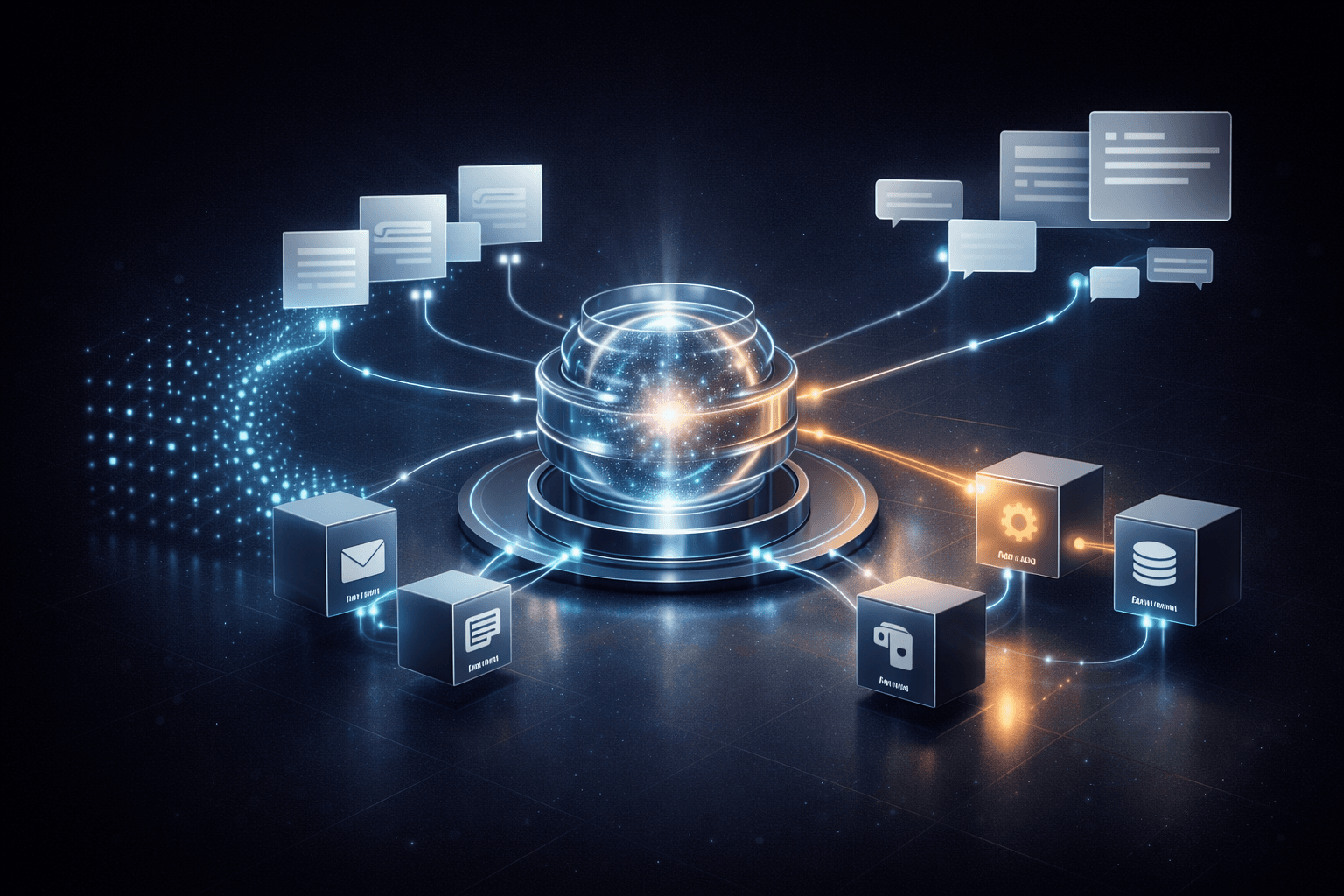
We integrate LLMs with secure data access, tool routing, and evaluation pipelines to maintain quality, cost, and compliance in production.
Outcomes
Measurable results from reliable delivery
Production-ready AI systems with reliability and observability
Clear performance metrics tied to business outcomes
Secure integrations with your data and workflows
Consistent LLM behavior with traceable tool usage
Deliverables
What you get with this service
Architecture blueprints and implementation plan
Evaluation and quality gates for safe releases
Telemetry dashboards and runbooks for operations
LLM orchestration layer with policy routing and guardrails
Use cases
Large Language Model (LLM) Integrations use cases we can help design
LLM-powered search and question-answering experiences connected to approved product, operational, or knowledge sources.
Model-enabled workflows that call internal APIs or business tools through explicit permissions, validation, and fallback paths.
Existing applications that need provider-agnostic model integration, response evaluation, and operational visibility.
Teams moving from one-off prompt experiments to an observable, governed LLM capability inside a real product.
Delivery approach
From workflow discovery to dependable operations
- 01
Map the user journey, source systems, data permissions, actions, and unacceptable failure modes.
- 02
Design the integration contract, retrieval or tool architecture, response controls, and evaluation cases.
- 03
Build the application integration and test behavior across normal, edge, and failure scenarios.
- 04
Release with telemetry, cost controls, incident guidance, and an iteration loop tied to real usage.
Related reading
Engineering insight for this service
From Raw Meeting Transcripts to Structured Minutes: Training DeBERTa for 'What Happened?' and 'What Changed?'
A practical pipeline for turning transcripts into structured minutes using DeBERTa classifiers.
Read articleMixture of Experts (MoE) Models: What They Are and Why They Matter
How MoE scales capacity with conditional compute--and why routing and balance matter.
Read articleRelated work
Selected relevant projects
Inbound Calling Platform with LiveKit, Custom STT, and LLM Orchestration
Production inbound calling system with real-time transcription, intent routing, and automated reports.
View projectQueryPilot: Natural Language to SQL Automation Platform
Schema-grounded NL to SQL with read-only guardrails and self-repair loops.
View projectVeriClaim: LLM-Powered Business Claim Verification for Trustworthy Content
Evidence-backed claim verification with verdicts, confidence, and citations.
View projectRelevant industries
Explore the operational contexts for Large Language Model (LLM) Integrations
These industry pages outline the workflows, constraints, and operating considerations that can shape this service. They do not by themselves represent client engagements in each sector.
Financial Services
Fraud, compliance, and decisioning pipelines with auditable evaluations and monitoring.
Explore Financial ServicesHealthcare and Life Sciences
Clinical and research workflows powered by governed retrieval and safe deployment.
Explore Healthcare and Life SciencesRetail and E-commerce
Personalization and support automation with reliable retrieval and A/B evals.
Explore Retail and E-commerceGovernment and Public Sector
Service automation and analytics with governance controls and traceability.
Explore Government and Public SectorFrequently asked questions
Planning a Large Language Model (LLM) Integrations project
Which LLM providers can you integrate?
The provider choice follows the product requirements, data boundaries, latency expectations, deployment constraints, and evaluation results rather than a one-size-fits-all default.
Can an LLM safely call our internal tools?
It can when tool permissions, input validation, approval paths, audit events, and failure handling are designed into the integration rather than left to the model alone.
How do you keep LLM costs predictable?
We make usage visible, define model-routing and context policies, evaluate quality against cost, and add limits or fallbacks where the workflow needs them.
Related services
Explore more in Artificial Intelligence and Machine Learning
AI Development Services
End-to-end AI development services for production model-flow systems, orchestration, evaluation, and deployment.
View serviceAI Automation
AI automation services for governed workflows that connect your systems, people, and operational data.
View serviceMachine Learning
Machine learning services for forecasting, scoring, and decision automation with monitoring and governance.
View serviceDeep Learning
Deep learning development for vision, language, and multimodal systems with optimized inference.
View servicePredictive Modeling
Predictive modeling services for forecasting, risk scoring, and decision support with validated accuracy.
View serviceComputer Vision
Computer vision services for inspection, detection, and real-time visual analytics in production.
View serviceNatural Language Processing (NLP)
NLP services for search, summarization, classification, and text analytics with safe retrieval.
View serviceGenerative AI
Generative AI services for RAG, agents, and copilots with governance and measurable ROI.
View serviceAI Chatbot Development
AI chatbot development for support and internal workflows with retrieval and controlled responses.
View serviceAI Business Solutions
AI business solutions aligned to revenue, cost, and operational ROI outcomes.
View serviceReady to build something dependable?
Tell us what you're building - we'll respond with a plan.